

CONTENT NOTE: This show contains some mature language and themes.
⧫
The show runs approximately two hours, including a 15 minute intermission.
⧫
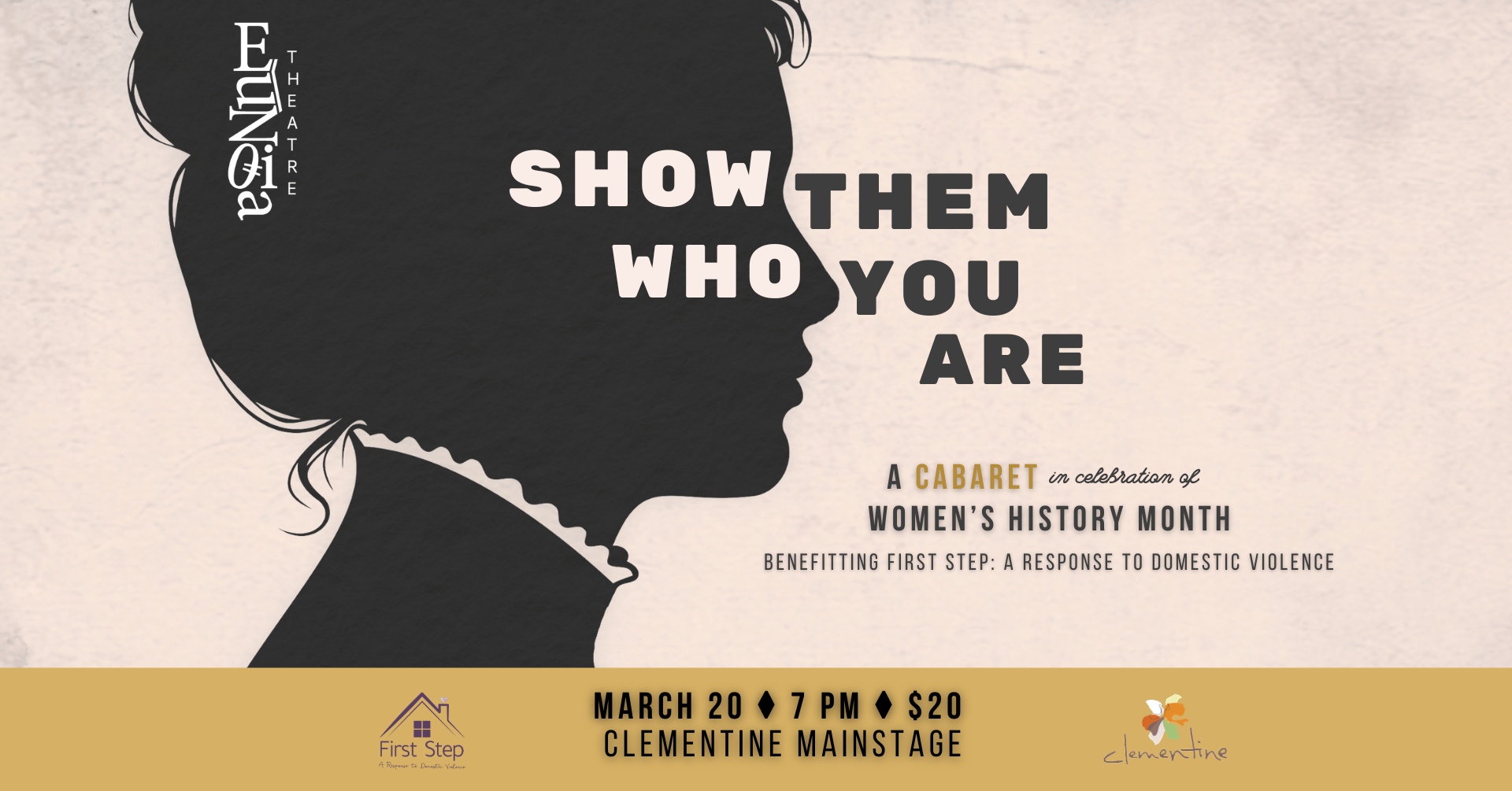
All proceeds to benefit First Step: A Response to Domestic Violence: a private, non profit organization that provides safe emergency shelter, support services, counseling, and resources to survivors of domestic and intimate partner violence. They are the only local non profit that provides comprehensive services including safe shelter to survivors in the City of Harrisonburg and the County of Rockingham and have done so for over forty years.
P R O G R A M
A C T I
“Show Them Who You Are” by Shaina Taub
performed by the ensemble
KATHERINE OF ARAGON
performed by Sarah Levine McClelland
excerpts from letter to King Henry VIII, 1535, speech at the Legatine Court of Blackfriars, 1529 & original text
“Not Ready to Make Nice” by Emily Robison, Martie Maguire, Natalie Mains, and Dan Wilson for The Chicks
ROSALIND FRANKLIN
performed by Agori Padgett
quotes & original text
“Monster” by Kristen Anderson-Lopez and Robert Lopez
HALLIE FLANAGAN
performed by Aili Huber
excerpts from Arena by Hallie Flanagan, original text
"Afterlife” by Ingrid Michaelson, Brian Lee, and Adam Pallin
performed by the ensemble
REMARKS from FIRST STEP: A RESPONSE TO DOMESTIC VIOLENCE
Candy Phillips, Executive Director
RACHEL CARSON
performed by Fleta Hylton
featuring Judith Hoffman (violin)
excerpts from The Sense of Wonder and Silent Spring by Rachel Carson & original text
"Shenandoah” (traditional)
“Come Ready and See Me” by Richard Hundley
“Unwritten” by Natasha Bedingfield, Danielle Brisebois, and Wayne Rodrigues
performed by Grace Altman, Diana Black, Aili Huber, Sarah Levine McClelland, Reavey Milton, Becca Stehle
ISABELLA BIRD
performed by Grace Altman
excerpt from A Lady’s Life in the Rocky Mountains by Isabella Bird & original text
"Get Lost” by Abigail Barlow and Emily Bear
A C T I I
LUCY STONE
performed by Reavey Milton
excerpts from Lucy Stone, “The Progress of Fifty Years,” World’s Columbian Exhibition, Chicago, 1893; original text
"The Baton” by Katie Gavin
performed by Sarah Levine McClelland, Reavey Milton, Becca Stehle, Judith Hoffman (violin), Catherine Holcomb (percussion)
EMMA LAZARUS
performed by Diana Black
“The New Colossus” by Emma Lazarus, quotes, & original text
"When We Look Back” by Michael Roberts
MARILYN MONROE
performed by Becca Stehle
excerpts from My Story by Marilyn Monroe
“The Angel Song” by Mark Kendall and Alan Niven for Great White
ANNIE OAKLEY
performed by Kelsey Harrison
quotes & original text
“The Warrior” by Nick Gilder and Holly Knight for Scandal
JOSEPHINE BAKER
performed by Christabell DeMichele
Excerpts from Josephine Baker, "Speech at the March on Washington for Jobs and Freedom,” 1963
"I Was Here” by Diane Warren for Beyoncé
FINALE
performed by the ensemble
"Bread and Roses,” words by James Oppenheim (1911), music by Mimi Fariña (1974)
"Light of a Clear Blue Morning” by Dolly Parton, as performed by The Wailin’ Jennys
arranged by Sarah Levine McClelland
quotes compiled by Amanda Saufley
All original text written by the ensemble.
accompanist
Kemper McCauley
directed by
Grace Altman ⧫ Diana Black ⧫ Sarah Levine McClelland ⧫ Becca Stehle
produced by
Alison Trocchia
lighting and sound
Catherine Holcomb ⧫ Abby Greenstreet
supplemental historical research
Amanda Saufley
special thanks
Clementine Cafe, First Step: A Response to Domestic Violence, Bridgewater College, Eastern Mennonite University, Gift & Thrift, James Madison University, Larry Rickard, Valley Creative Reuse
F U R T H E R R E A D I N G
Katherine of Aragon: (1485-1536) Married to King Henry VIII, Katherine of Aragon was Queen of England for 20 years. As the daughter of Queen Isabella and King Ferdinand, she received a classical education and was well-respected for her scholarship, particularly in Latin and theology. Before marrying Henry, Katherine was married to his older brother, Arthur; a marriage intended to seal an alliance between England and Spain, but Arthur died just months after their wedding. With Henry, Katherine bore six children; but only one daughter, Mary I, survived to adulthood. Fueled by the desire for a male heir, Henry sought an annulment on the grounds that Katherine’s previous marriage to his brother made their union illegitimate, although Katherine swore her first marriage was never consummated. Henry ultimately broke from the Catholic church and established the Church of England in order to divorce her. Katherine refused to acknowledge the divorce, publicly or privately. As punishment, Henry kept her separated from her daughter Mary. Katherine died at the age of 50, likely from cancer, though popular rumors of the day suggested poisoning by Henry’s second wife, Anne Boleyn.
Rosalind Franklin: (1920-1958) Often referred to as “the dark lady of DNA” or the “forgotten heroine,” Rosalind Franklin was a British Jewish chemist, holding a PhD from Cambridge University. While working as a researcher at King’s College, Franklin’s work with x-ray crystallography led to her discovery of the double-helix shape of DNA in 1952, with a photo known as Photo 51. Shortly after this discovery, Franklin left King’s College for a new research position studying RNA. Her discovery was published by Nobel prize winners Watson and Crick in 1953, without acknowledging her groundbreaking contribution. Franklin spent the rest of her career studying polio before passing away at age 37 from ovarian cancer.
Hallie Flanagan: (1890-1969) Hallie Flanagan was an American theatrical producer and director, playwright and author, best known for running the Federal Theatre Project (FTP), a part of the Works Progress Administration during the New Deal. While working as a professor at Vassar College she became the first woman awarded a Guggenheim Fellowship to study theatre in 1926. In 1934, head of the WPA and former college classmate of Flanagan’s, Harry Hopkins, asked her to head the Federal Theatre Project. Under her leadership, the project employed thousands of artists and produced innovative, socially engaged performances including children’s theatre and Living Newspaper plays. By 1936, the FTP employed 12,500 artists and played weekly to audiences of 350,000 across the United States. In 1939, Flanagan was called to testify before the House Un-American Activities Committee, accused of supporting a communist agenda and subverting American values through the FTP. After just four years, the FTP was shut down and Flanagan returned to teaching at Vassar College, later retiring from Smith College.
Rachel Carson: (1907-1964) Best known for her book Silent Spring exposing the dangers of chemical pesticides, Rachel Carson was a marine biologist, writer and environmental activist. Carson spent much of her professional career working for the U.S. Fish and Wildlife service, eventually serving as the editor in chief of all USFWS publications. Her work led to the establishment of the Environmental Protection Agency and the first Earth Day celebration in 1970. Carson died of breast cancer before she was able to see the full influence of Silent Spring, including the ban of DDT in 1972.
Isabella Bird: (1831-1904) Isabella Bird was a British explorer, writer, and photographer known for her adventurous travels in the 19th century. From early childhood in Yorkshire, she struggled with chronic illness, but found that travel improved her health. Defying Victorian expectations for women, she journeyed across places such as Colorado, Japan, and Korea, documenting landscapes and cultures in vivid detail. Her book A Lady's Life in the Rocky Mountains brought her widespread fame. Despite her lack of formal education, she became the first woman elected to the Royal Geographical Society in 1892, inspiring future generations of women travelers.
Lucy Stone: (1818-1893) Lucy Stone was a political organizer, newspaper editor, suffragist and abolitionist. Stone was the first Massachusetts woman to graduate from college, earning a degree at Oberlin College. Stone broke from others in the women’s suffrage movement over the passing of the 15th Amendment, which granted voting rights to Black men, while still excluding all women. Stone supported the amendment, believing it to be an important step toward equal rights for all, but other leaders believed it to be a betrayal of their cause. The battle of over equal rights for women of all races led Stone and fellow suffragists Julia Ward Howe and Mary Livermore to found the American Woman Suffrage Association, in order to work for suffrage without compromising on issues of racial equality, separating from famed Elizabeth Cady Stanton and the National Women’s Suffrage Association.
Emma Lazarus: (1849-1887) One of the first successful Jewish American authors, Emma Lazarus was recognized by contemporaries as an important poet. During a time of rising Antisemitism, when many spaces and opportunities were closed to Jews, she publicly and proudly proclaimed her identity. Horrified by the pogroms in Eastern Europe and the appalling conditions Jewish refugees suffered upon arriving in America, Lazarus advocated for Jewish rights, including self-determination in their ancestral homeland. She also helped establish a vocational school for immigrants. “The New Colossus” was presented at a fundraiser for the pedestal of the Statue of Liberty. After her death, Lazarus’s friends arranged to have it engraved on a plaque at the pedestal, her words becoming almost as famous as the statue itself.
Marilyn Monroe: (1926-1962) Marilyn Monroe was an actress, model and cultural icon of the 1950s. Born Norma Jeane Mortensen, she experienced a difficult upbringing. Her mother struggled with mental illness, and she spent much of her childhood in and out of multiple foster homes and orphanages. Monroe dropped out of school at 15 and married her first husband, James Dougherty at 16. Monroe began modeling and divorced Dougherty by age 20, making her first film in 1947 at age 21. Known for her roles in Gentlemen Prefer Blondes and The Seven Year Itch, she studied at the Actors Studio and went on to make a total of 29 films, winning three Golden Globe awards. After a lifetime of trauma and struggle with addiction, Monroe died at age 36 of an overdose.
Annie Oakley: (1860-1926) Annie Oakley was a legendary American sharpshooter, who rose from poverty to international fame. Born Phoebe Ann Mosey in 1860 in rural Ohio, she learned to hunt as a young child to help support her family after her father’s death. Her remarkable marksmanship led her to join Buffalo Bill's Wild West show, where she amazed audiences by shooting coins in the air and performing complex trick shots, including her most famous: shooting a playing card (often the ace of spades) multiple times from 30 paces away before it touched the ground, frequently splitting the card edge-on. Oakley became one of the show’s biggest stars and toured internationally, earning great wealth. Oakley supported women’s independence and believed women should learn shooting skills for self-reliance and confidence, and donated generously to organizations for women and children in poverty.
Josephine Baker: (1906-1968) Josephine Baker was an African American dancer, singer, actress, and civil rights activist who found fame as an expatriate performer in Europe. Baker was born Freda Josephine McDonald in St. Louis, Missouri, to a washerwoman and vaudeville performer. Having experienced the horrors of the East St. Louis riots in 1917, she embraced her talents as a way out of discrimination and poverty. She was the first African American woman to star in a motion picture, to perform with an integrated cast at the American concert hall, and one of the first African American entertainers who achieved acclaim both in movies and on the stage. During World War II, Baker performed for integrated audiences of French and American troops. She also served as a member of the French Resistance forces and smuggled messages in her lyrics that were sent back to France from opposing forces. She received the Croix de Guerre for her efforts. Baker later returned to America to take part in the Civil Rights Movement. She was the only female speaker at the March on Washington in 1963, where she honored women civil rights activists.
Our finale features excerpts of quotations by suffragists, labor leaders, and activists spanning from 1911, the year of the first International Women’s Day to the present. Below are the full quotes and their attributions.
“In agreement with the class-conscious political and trade union organizations of the proletariat of their respective countries, socialist women of all nationalities have to organize a special Women’s Day (Frauentag), which must, above all, promote the propaganda of female suffrage. This demand must be discussed in connection with the whole woman’s question, according to the socialist conception.”
From the 1911 International Conference of Socialist Women resolution proposing International Women’s Day.
“Not at once; but woman is the mothering element in the world and her vote will go toward helping forward the time when life's Bread, which is home, shelter and security, and the Roses of life, music, education, nature and books, shall be the heritage of every child that is born in the country, in the government of which she has a voice.”
Helen Todd (1870-1953), Suffragist & Labor Activist. Credited with the origin of the phrase bread and roses in a Suffrage Special speech in 1910.
“We, the 20,000 textile workers of Lawrence, are out on strike for the right to live free from slavery and starvation; free from overwork and underpay; free from a state of affairs that had become so unbearable and beyond our control, that we were compelled to march out of the slave pens of Lawrence in united resistance against the wrongs and injustice of years and years of wage slavery…. We hold that as useful members of society and as wealth producers we have the right to lead decent and honorable lives; that we ought to have homes and not shacks; that we ought to have clean food and not adulterated food at high prices; that we ought to have clothes suited to the weather and not shoddy garments. That to secure sufficient food, clothing and shelter in a society made up of a robber class on the one hand and a working class on the other hand, it is absolutely necessary for the toilers to band themselves together and form a union, organizing its powers in such form as to them seem most likely to effect their safety and happiness.”
From the Proclamation of the Striking Textile Workers of Lawrence, issued by the Strike Committee (International Workers of the World), 1912
"What the woman who labors wants is the right to live, not simply exist — the right to life as the rich woman has the right to life, and the sun and music and art. You have nothing that the humblest worker has not a right to have also. The worker must have bread, but she must have roses, too. Help, you women of privilege, give her the ballot to fight with."
Rose Schneiderman (1882-1972), Suffragist, Labor Organizer, NY Labor Secretary. Credited with popularizing the phrase “Bread and Roses” after the strike.
“The first thing is to raise hell. That’s always the first thing to do when you’re faced with an injustice and you feel powerless. That’s what I do in my fight for the working class.”
Mary Harris Jones “Mother Jones” (1837-1930), Irish-American Union Organizer
“The way to right wrongs is to turn the light of truth upon them.”
Ida B. Wells-Barnett (1862-1931), Emancipated Slave, Journalist, Anti-lynching activist, Suffragist, and early civil rights movement leader.
“When the ballot is put into the hands of the American woman the world is going to get a correct estimate of the Black woman. It will find her a tower of strength of which poets have never sung, orators have never spoken, and scholars have never written.”
Nannie Helen Burroughs (1879-1961), Suffragist
“You cannot be neutral. You must either join with us who believe in the bright future or be destroyed by those who would return us to the dark past.”
Daisy Elizabeth Lampkins (1884-1965), Suffragist
“To bring about change, you must not be afraid to take the first step. We will fail when we fail to try.”
Rosa Parks (1913-2005), Civil Rights Activist Leader
"We're half the people; we should be half the Congress."
Janette Rankin (1880-1973), First woman elected to US Congress in 1916, prior to passage of 19th amendment in 1920.
“If they don’t give you a seat at the table, bring in a folding chair.”
Shirley Chisholm, (1924-2005), First black woman elected to Congress
“We believe that improvements in the lives of women cannot and must not await the outcome of deliberations on the new economic order. We women will no longer be excluded from the sphere of decisions, so we should reject the concomitant dominance and power that we have experienced. We women will no longer be relegated either here or in our own countries to a secondary place when hard politics are being discussed as distinct from soft women's issues. We reject this distinction; it is the distinction between the personal and the political. It is a part of our present oppression. We women will no longer be manipulated for political ends either in the International or in the national forum. This deprives us of our dignity. We women will no longer tolerate paternalism, benign or otherwise, for it deprives us of our self and this is our conference.”
Elizabeth Reid (1942–), Australian, first woman advisor to a prime minister, in her speech to the 1975 UN World Conference of Women’s Year.
“Women belong in all places where decisions are being made. It shouldn’t be that women are the exception.”
Ruth Bader Ginsburg (1933-2010), Supreme Court Justice, Women’s Rights Activist
“Every moment is an organizing opportunity, every person a potential activist, every minute a chance to change the world.”
Dolores Huerta (1930–), United Farm Workers Association Co-Founder, labor activist, women’s advocate, Chicano civil rights activist. Credited with “Sí, se puede” (yes, we can!), the rallying cry of UFW.
“The future depends entirely on what each of us does every day; a movement is only people moving.”
Gloria Steinem (1934–), Women’s Rights Activist
"The most common way people give up their power is by thinking they don’t have any.”
Alice Walker (1944–), Author (The Color Purple) and Civil Rights Activist
“You have to act as if it were possible to radically transform the world. And you have to do it all the time.”
Angela Davis (1944–), Civil Rights Activist, Abolitionist, Queer Activist
“Let us be the ancestors our descendants will thank.”
Winona LaDuke (1959–), Native American Rights and Environmental Activist